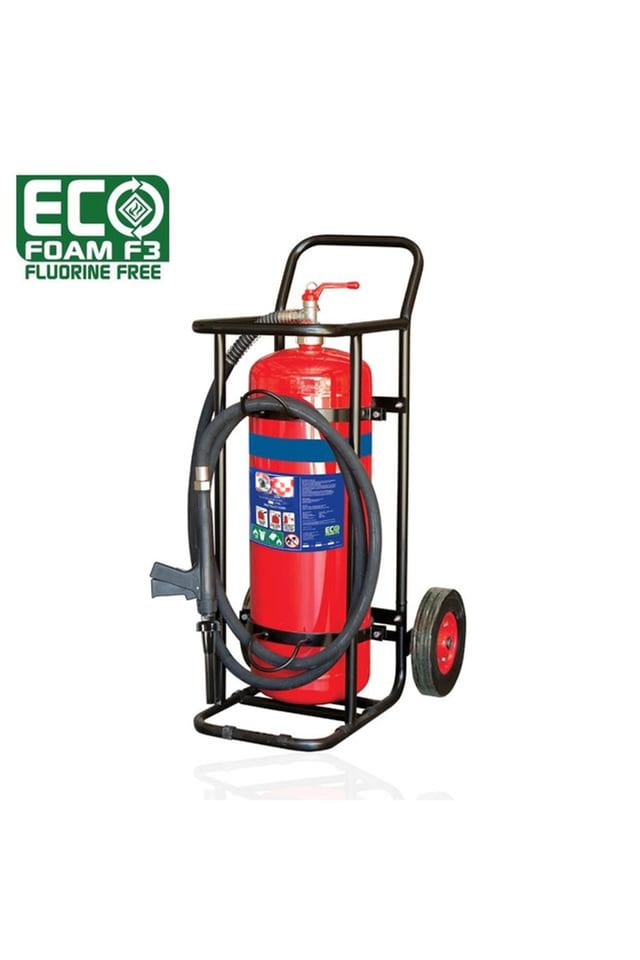
50 L Mobile Foam Fire Extinguisher
$2,420.00
50 litre ECO fluorine free foam mobile fire extinguisher on solid rubber wheel trolley. Suitable for Class A and B fires — flammable liquids, paper, textiles and combustibles. PFOS and PFOA free.
Out of stock
Description
The 50 litre ECO fluorine free foam mobile fire extinguisher provides large-scale Class A and B suppression without the environmental risks of traditional AFFF (aqueous film-forming foam) — no PFOS, no PFOA, no fluorine compounds. The F3 concentrate creates a stable foam blanket that seals liquid fires from oxygen and prevents reignition, making it the right choice for high-risk flammable liquid environments where both suppression performance and environmental responsibility are required. Mounted on a solid rubber wheel trolley at 98kg gross weight.
Approved to AS/NZS 1841.4. Suitable for Class A fires (wood, paper, textiles, rubber and plastics) and Class B fires (flammable liquids — petrol, oil, solvents, hydraulic fluids). Not rated for Class E (electrical) fires — do not use on or near energised electrical equipment.
Key Features
- 50 litre Eco Foam-F3 concentrate — fluorine free, PFOS and PFOA free
- Class A and B coverage — wood, paper, flammable liquids
- Stainless steel cylinder — corrosion resistant
- Solid rubber wheel trolley — stable deployment on hard surfaces
- Red powder coat finish, steel handle
- 5-yearly hydrostatic pressure test required
Technical Specifications
- Agent Capacity: 50 litres
- Agent Type: Eco Foam-F3 Concentrate (Fluorine Free)
- Fire Rating: 3A:20B (per 9L of extinguishant)
- Class: AB
- Gross Mass: 98kg
- Overall Dimensions: W534 × D686 × H1150mm
- Cylinder: Stainless steel, powder coated red
- Cylinder Pressure Test: 5-yearly at 2.7MPa (1620kPa working pressure)
- Tyres: Hard rubber
- Valve: Nickel coated brass, brass stem
- Approvals: AS/NZS 1841.4
Compliance & Servicing
Approved to AS/NZS 1841.4. Mobile foam extinguishers must be inspected every 6 months and serviced annually in accordance with AS 1851 by a licensed fire protection technician. Foam concentrate must be checked for degradation at each service. The cylinder requires hydrostatic pressure testing every 5 years at 2.7MPa. Your fire protection technician can advise on concentrate top-up and refill requirements specific to this unit.
Frequently Asked Questions
Where 50L Foam Mobile Extinguishers Are Specified
- Fuel farms and bulk liquid storage facilities
- Marine and coastal fuel storage areas
- Aviation fuel handling and aircraft aprons
- Industrial spill and bunding areas
- Paint and solvent storage rooms
- Facilities subject to environmental regulations requiring fluorine-free foam
- Any high-hazard Class B environment requiring large-volume foam suppression
What makes the ECO F3 foam fluorine free — and why does it matter?
Traditional AFFF foam contains PFOS (perfluorooctane sulfonate) and PFOA (perfluorooctanoic acid) — persistent organic pollutants that accumulate in the environment and have been linked to health concerns. These compounds are now restricted or banned under several Australian and international regulations. The F3 ECO foam uses a hydrocarbon-based concentrate that achieves equivalent suppression performance on Class B fires without fluorine compounds. For facilities subject to environmental regulation, stormwater discharge controls, or near sensitive waterways, fluorine-free foam is the responsible and increasingly mandatory choice.
Can foam be used on a petrol fire?
Yes — Class B foam extinguishers are specifically designed for flammable liquid fires including petrol, diesel, oil, hydraulic fluid, and most solvents. The foam blanket floats on the liquid surface, cutting off oxygen supply and preventing vapour release. This is a critical advantage over ABE powder, which can allow reignition if the burning liquid surface is disturbed after discharge. For bulk petrol or liquid fuel fires, the foam mobile provides a more effective and persistent suppression action than dry chemical powder alternatives.
Why can’t foam be used on electrical fires?
Foam concentrate (even fluorine-free) is electrically conductive. Discharging foam onto energised electrical equipment can create a conduction path between the live equipment and the operator. Foam extinguishers are not rated for Class E (electrical) fires. If your environment has both flammable liquid and electrical risks, position a separate CO2 extinguisher for the electrical equipment and a foam mobile for the liquid fuel areas. Your fire protection engineer can advise on the correct specification for mixed-risk environments.
What is the difference between foam and ABE powder for flammable liquid fires?
Both can tackle Class B fires, but they behave very differently. ABE powder provides fast knockdown but does not cool the burning liquid and can allow reignition — particularly on large liquid pool fires where the powder is dispersed quickly. Foam creates a lasting blanket that seals the liquid surface and is much harder to disturb, making it more reliable for large-area liquid fire control. Foam is also easier to manage post-event (no corrosive powder residue), but cannot be used near electrical equipment. For high-hazard liquid fuel environments, foam is generally the preferred suppression agent.
Is delivery available for the 50L mobile foam extinguisher?
Yes — delivery is available Australia-wide. At 98kg gross weight, this is a freight item delivered to the kerb or dock. Ensure ground-floor access and appropriate handling equipment (pallet jack or forklift) is available at the delivery address. Contact us before ordering if you have specific access requirements. Same-day dispatch applies to in-stock items.
Additional information
| Weight | 86.65 kg |
|---|