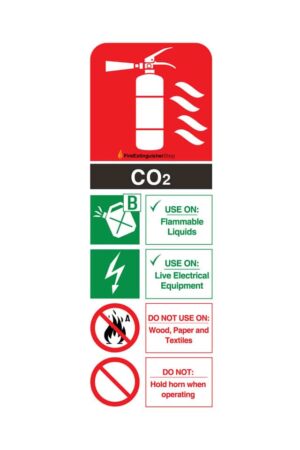
CO2 fire extinguishers use pressurised carbon dioxide gas to extinguish fires — no powder, no foam, no residue. That makes them the right choice for electrical equipment, server rooms, laboratories, and any environment where cleanup or equipment damage matters.
What are CO2 fire extinguishers used for?
CO2 extinguishers are rated for two fire classes:
- Class B — flammable and combustible liquids: petrol, oil, solvents, and paints
- Class E — electrical fires: switchboards, computers, servers, wiring, and appliances
Because CO2 leaves no residue, it is the preferred extinguisher wherever equipment damage from powder or foam would cause secondary losses — data centres, commercial kitchens (non-cooking area), medical facilities, and offices with expensive electronics.
Note: CO2 is not effective on Class A fires (wood, paper, fabric). For general-purpose use, see our dry chemical ABE extinguishers.
Choosing the right CO2 extinguisher size
| Size |
Best for |
Total weight |
| 2kg CO2 |
Small server rooms, reception areas, under-desk mounting |
~5kg |
| 3.5kg CO2 |
Most common office and commercial size |
~8kg |
| 5kg CO2 |
Larger areas, plant rooms, higher-risk electrical environments |
~12kg |
| 45kg CO2 Mobile |
Large plant rooms, data halls, high-value electrical switchgear |
Trolley-mounted |
How does a CO2 extinguisher work?
When discharged, liquid CO2 rapidly expands into gas, displacing oxygen around the fire and cooling the burning material. The gas dissipates cleanly — there is no powder residue, no water damage, and no contamination of sensitive equipment. This is why CO2 is specified for IT rooms and laboratory environments.
Compliance and servicing
All CO2 extinguishers in this range comply with AS/NZS 1841 (portable fire extinguishers). CO2 cylinders require hydrostatic testing every 5 years and a 6-monthly inspection under AS 1851. A licensed fire protection technician must carry out all servicing.
Frequently asked questions
What colour band does a CO2 fire extinguisher have?
CO2 extinguishers are identified by a black band on a red body, as specified by AS 1841. The black colour code is the universal identifier for CO2 agents across Australian and international standards.
Are CO2 extinguishers safe to use on electrical fires?
Yes — CO2 is non-conductive and leaves no residue, making it the safest option for live electrical equipment. It will not short-circuit equipment or cause corrosion. Always isolate the power source if safe to do so before discharging.
Can I use a CO2 extinguisher indoors?
Yes, but use with care in small enclosed spaces. CO2 displaces oxygen, which can create a temporary low-oxygen environment in very small rooms. Ventilate the area immediately after use. CO2 is widely used indoors in server rooms and offices across Australia.
What is the difference between CO2 and dry chemical fire extinguishers?
Dry chemical (ABE powder) covers Class A, B, and E fires but leaves a fine powder residue that can damage electronics and requires cleanup. CO2 covers Class B and E fires only but leaves zero residue — it is the preferred choice wherever equipment damage matters. For most workplaces that need both coverage and clean discharge, CO2 is often used alongside an ABE unit.
How often does a CO2 extinguisher need to be serviced?
A basic inspection every 6 months and a full hydrostatic pressure test every 5 years, as required by AS 1851. CO2 cylinders must be weighed at each inspection — if the weight has dropped by more than 10%, the cylinder needs refilling.